
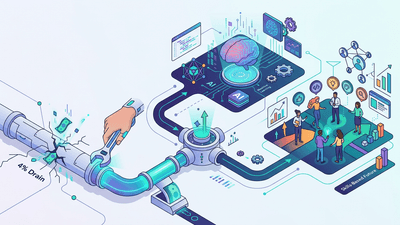



Imagine walking into your Chief Financial Officer’s office and admitting that up to 4% of the company’s total labor budget simply evaporated last year. It wasn’t spent on strategic talent acquisition, nor was it invested in competitive employee benefits. Instead, it vanished into the ether of outdated processes, system glitches, and administrative friction. For a Fortune 500 company with a billion-dollar payroll, that is a $40 million blind spot. In 2026, as HR departments face intense scrutiny over return on investment, this invisible drain is rapidly becoming public enemy number one.
According to a sobering new analysis, this scenario isn't a hypothetical nightmare—it is a daily reality for millions of businesses. A joint report from UKG and KPMG reveals that "payroll leakage" caused by bad processes and system limitations can prompt up to a 4% loss of total labor spend for large employers. As U.S. organizations navigate a volatile economic landscape, plugging these operational holes is no longer just an administrative task; it is a strategic imperative that dictates HR's ability to fund the future of work.
The Mechanics of the Multi-Million Dollar Leak
Payroll leakage rarely happens through massive, headline-grabbing errors. Instead, it is a death by a thousand cuts. It occurs in the gray areas between fragmented HR systems, manual timekeeping workarounds, and complex, ever-changing compliance mandates.
"Payroll leakage is the silent killer of HR credibility. When core administrative systems fail to accurately track, calculate, and disburse labor dollars, it undermines every other strategic initiative the people function attempts to champion."
When systems fail to communicate, HR and payroll professionals are forced into manual data entry, increasing the likelihood of human error. Overpayments, unapproved overtime, misclassified worker statuses, and "buddy punching" all contribute to the steady drip of lost capital.
| Source of Leakage | Common Causes | Business Impact |
|---|---|---|
| Time & Attendance Friction | Manual timesheets, rounding errors, buddy punching | Inflated hourly payouts, unbudgeted overtime |
| System Disconnection | Siloed HRIS and payroll platforms, delayed offboarding | Paying "ghost employees," duplicate data entry errors |
| Compliance & Classification | Misapplied shift differentials, FLSA misclassification | Regulatory fines, back-pay settlements, legal fees |
To combat this, HR leaders must conduct end-to-end audits of their payroll lifecycle, identifying where manual interventions are required and where data silos exist. But auditing is only the first step. The ultimate solution lies in modernizing the technological infrastructure that governs these processes.
The Tech Cavalry: Enter Agentic AI
For years, HR technology has promised seamless integration, but often delivered clunky dashboards that still required human operators to pull the levers. In 2026, the paradigm is shifting from passive software to proactive, autonomous systems.
A prime example of this evolution is happening in the enterprise software space. Oracle has launched new Fusion Agentic Applications specifically designed to enhance end-to-end HR solutions and improve workplace intelligence. Unlike generative AI, which primarily assists with content creation or data summarization, agentic AI is capable of taking autonomous action based on predefined rules and real-time data analysis.
In the context of payroll leakage, agentic applications act as tireless auditors. These systems can continuously monitor time-and-attendance feeds, flag anomalous overtime patterns before the payroll run is finalized, and automatically reconcile data discrepancies between HRIS and finance ledgers. By deploying agentic AI, HR departments can shift their focus from retroactive error correction to proactive financial stewardship.
Strategic Compliance: The New Corporate Shield
Stopping financial leakage isn't just about protecting the payroll budget; it’s also about mitigating catastrophic legal risks. The administrative rigor required to ensure accurate payroll is the exact same rigor required to protect the company in court.
This convergence of administration and risk management is a central theme in the newly released HR Voices 2026 Report by OutSolve. Gathering insights from top HR influencers, the report underscores a massive industry shift: HR compliance is moving away from reactive administration and evolving into strategic risk management.
Consider the vital importance of documented, systemic communication between HR and management. A recent court ruling involving a security guard's retaliation claim perfectly illustrates this point. The former employee alleged that his supervisor manipulated a manager into firing him in retaliation for prior HR complaints. However, the court ruled in favor of the employer because it was demonstrably proven that the firing manager was entirely unaware of the guard's prior complaints.
This case, often referred to under the "cat's paw" theory of liability, highlights why robust, centralized HR systems are non-negotiable. When an organization has a watertight system of record—clearly delineating who knew what, when they knew it, and how decisions were made—it creates an impenetrable shield against frivolous litigation. Poor record-keeping is just another form of leakage, one that drains resources through legal settlements rather than payroll errors.
Steps to Shift from Reactive to Strategic Compliance:
- Centralize Employee Relations Data: Ensure all complaints, performance reviews, and disciplinary actions are logged in a single, auditable system.
- Implement Access Controls: Clearly define and track which managers have access to specific employee relations files to prevent (and disprove) claims of biased decision-making.
- Automate Compliance Updates: Utilize AI-driven platforms to automatically update internal policies in response to shifting state and federal labor laws.
Reinvesting the Savings: The Skills-Based Revolution
If an HR department successfully plugs a 4% payroll leak and fortifies its compliance infrastructure against costly litigation, what happens to the saved capital? In 2026, the most forward-thinking organizations are reinvesting those funds directly into the front end of the talent lifecycle: skills-based hiring.
The traditional reliance on four-year degrees and linear career histories is rapidly becoming obsolete, replaced by a hyper-focus on verified competencies. Reflecting this massive market shift, OneTen has officially rebranded as SkillsRight, signaling a deepened commitment to driving skills-based hiring initiatives and improving corporate talent acquisition strategies.
This rebrand is highly symbolic of the broader HR landscape. Organizations are recognizing that the talent shortage cannot be solved by fishing in the same traditional, degree-filtered ponds. By transitioning to a skills-first approach, employers can tap into vast pools of historically overlooked talent, including veterans, self-taught technologists, and workers transitioning from declining industries.
However, implementing a true skills-based hiring model requires significant investment. HR must rewrite job architectures, implement new pre-employment assessment technologies, and train hiring managers to evaluate competencies rather than pedigrees. This is exactly why stopping payroll leakage is so critical. The millions of dollars saved by optimizing back-office operations provide the exact funding needed to revolutionize front-office talent acquisition.
The 2026 Mandate: Operational Rigor as the Foundation of Innovation
As we look deeper into 2026, the mandate for U.S. HR professionals is fundamentally dual-natured. On one hand, HR must be the visionary architect of the future workforce—championing skills-based hiring, fostering inclusive cultures, and deploying cutting-edge AI.
On the other hand, HR must be a ruthless operator. The most visionary talent strategy in the world will collapse if the underlying administrative plumbing is leaking millions of dollars. By embracing agentic AI to fix payroll processes, adopting a strategic approach to compliance risk, and reinvesting the savings into modern talent acquisition, HR leaders can prove their undeniable impact on the bottom line. The future of HR isn't just about managing people; it's about mastering the systems that empower them.