
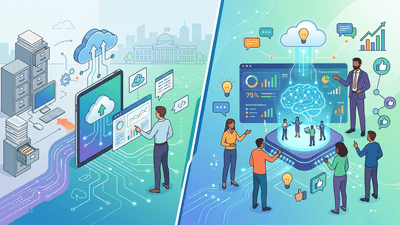



In the trenches of human resources, your strategy is only as agile as the technology powering it. For years, US HR professionals have graumbled about the widening gap between consumer-grade technology and the clunky, legacy systems they are forced to use at work. But as we navigate 2026, a massive structural shift is underway in the HR tech ecosystem. We are witnessing a two-speed modernization effort: a race to drag essential, foundational systems into the cloud, paired with a simultaneous leap into predictive, AI-driven employee engagement.
Two recent market moves perfectly encapsulate this bimodal reality. On one end of the spectrum, ZenaTech is acquiring NOW Solutions to overhaul public sector HR Software-as-a-Service (SaaS). On the other, Workday has unveiled a sophisticated AI recognition tool designed to decode workplace culture and drive retention. Together, these developments offer a masterclass in how US employers must evaluate their tech stacks—not just as administrative tools, but as critical levers for organizational survival.
The Public Sector Catch-Up: Building a Strong SaaS Foundation
The United States public sector employs over 20 million people across federal, state, and local governments. Yet, despite being one of the largest employer demographics in the country, public sector HR has long been plagued by chronic underinvestment in technology. Many municipalities and agencies still rely on on-premise, decades-old software for critical functions like payroll and benefits administration.
This makes ZenaTech’s acquisition of NOW Solutions a highly strategic play. NOW Solutions has a long-standing reputation as a reliable human resource and payroll software provider. By bringing NOW Solutions under its umbrella, ZenaTech is signaling a targeted push to deliver modernized HR SaaS specifically tailored to the rigorous compliance, security, and scale requirements of the public sector.
Why This Matters for Foundational HR
For HR leaders stuck in legacy environments, the shift to SaaS isn't just about a sleeker user interface; it is about risk mitigation and operational continuity. Foundational HR tech must address:
- Payroll Accuracy and Compliance: Cloud-based systems update automatically to reflect changing tax codes and labor laws, drastically reducing compliance risks.
- Data Security: Modern SaaS architectures offer enterprise-grade encryption and access controls, which are vital for protecting sensitive employee data against increasing cyber threats.
- Self-Service Capabilities: Empowering employees to manage their own basic HR needs (like updating direct deposits or requesting PTO) frees up HR teams to focus on strategic initiatives rather than administrative triage.
"You cannot build a high-performance culture on a foundation of broken payroll and manual data entry. Modernizing the base layer of HR tech is the non-negotiable first step toward strategic workforce management."
The Enterprise AI Leap: Decoding Engagement and Retention
While the public sector focuses on establishing a robust SaaS baseline, the private enterprise sector is aggressively pushing the boundaries of what HR tech can achieve. Foundational payroll and benefits administration are now table stakes. The new frontier is the employee experience.
Enter Workday’s latest innovation. The HR tech giant recently launched a new AI-powered platform designed to help companies reward employees, elevate workplace culture, and generate real-time business insights. This isn't your traditional, static "Employee of the Month" module.
The Mechanics of AI-Powered Recognition
Workday’s tool leverages artificial intelligence to seamlessly integrate recognition into the daily flow of work. In an era where hybrid and remote work can make employees feel invisible, AI can identify patterns of collaboration, highlight cross-functional contributions, and prompt managers to acknowledge hard work when it happens—not just during annual reviews.
The strategic value of this technology lies in its ability to generate real-time business insights. By analyzing who is being recognized, for what, and by whom, HR leaders can map the informal influence networks within their organizations. They can identify flight risks before they happen, spot emerging leaders who might be overlooked by traditional metrics, and quantify the ROI of their culture-building initiatives.
Navigating the Two-Speed Tech Landscape: A Guide for HR Leaders
For HR professionals in the US, the contrast between ZenaTech's infrastructure play and Workday's AI innovation highlights a crucial strategic imperative: You must align your technology investments with your organization's digital maturity.
Deploying an advanced AI recognition tool will fail if your employees are still dealing with payroll errors due to an antiquated core HRIS. Conversely, resting on your laurels just because you successfully migrated to the cloud three years ago will leave you vulnerable to competitors who are using AI to poach your top talent.
Assessing Your Tech Stack
To determine where your organization should focus its budget and energy, consider the following bimodal breakdown:
| Focus Area | Phase 1: Foundational SaaS (e.g., ZenaTech/NOW) | Phase 2: Advanced AI (e.g., Workday) |
|---|---|---|
| Primary Goal | Compliance, accuracy, and operational efficiency. | Engagement, retention, and predictive analytics. |
| Target Audience | Public sector, heavily regulated industries, legacy enterprises. | High-growth tech, competitive corporate sectors, hybrid workforces. |
| Key Metrics | Payroll error rates, time-to-process, compliance audit scores. | eNPS, voluntary turnover rate, cross-departmental collaboration. |
| Employee Benefit | Frictionless administrative interactions (getting paid correctly and on time). | Feeling valued, visible, and connected to the corporate mission. |
Three Steps to Future-Proof Your HR Technology
- Conduct a Brutal Tech Debt Audit: Before chasing the shiny new AI tool, survey your workforce. If your employees complain about the difficulty of basic tasks (like finding their benefits information or logging hours), prioritize a foundational SaaS upgrade like the ones ZenaTech is bringing to the public sector.
- Demand Interoperability: Whether you are buying a core HRIS or a specialized AI engagement module, ensure the systems can talk to each other. Siloed data is the enemy of strategic HR. Workday’s success is largely due to its unified data model; ensure any vendor you choose can integrate cleanly into your broader ecosystem.
- Train for the Human-in-the-Loop: AI tools for recognition and engagement are powerful, but they are only prompts. HR must train managers to use these insights authentically. An AI-generated "thank you" feels robotic if the manager doesn't deliver it with genuine human empathy.
Looking Ahead: The Frictionless Future of Work
The HR technology market is bifurcating to meet employers exactly where they are. ZenaTech’s push into public sector SaaS proves that the massive, foundational overhaul of American HR infrastructure is still in full swing. Meanwhile, Workday’s AI innovations prove that for digitally mature companies, the battleground has shifted from administration to psychology.
Ultimately, the goal of both movements is identical: removing friction from the employee experience. Whether that friction is a delayed payroll run in a municipal office or a remote software engineer feeling unappreciated, the cost of inaction is turnover. As we look toward the remainder of 2026, the most successful HR leaders will be those who can seamlessly bridge the gap between rock-solid SaaS foundations and cutting-edge AI insights, creating a workplace that is both operationally flawless and deeply human.