
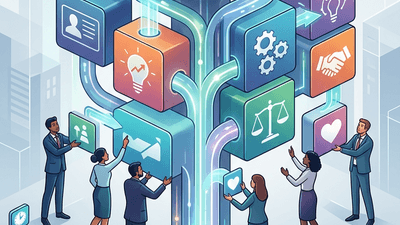



For the past five years, the average U.S. human resources department has been on a software shopping spree. In the rush to accommodate remote work, hybrid scheduling, and the sudden explosion of artificial intelligence, HR tech stacks have ballooned into bloated, fragmented webs of point solutions. Employees are exhausted by "app switching," and HR leaders are drowning in siloed data. But as we move deeper into 2026, a significant market correction is underway. The era of adopting tech for tech's sake is over. Today, the focus has shifted entirely toward consolidation, scalability, and ethical governance.
Recent moves by major HR technology players highlight a crucial turning point. From massive acquisitions designed to unify the employee experience to the implementation of strict ethical guardrails in hiring algorithms, the market is signaling that the future of HR tech is seamlessly integrated and distinctly human-centric. For HR professionals, understanding this convergence is no longer optional—it is the blueprint for building sustainable workforce operations.
The Consolidation of the Employee Experience
The modern employee experience (EX) has historically been divided: one platform for internal communications, another for desk booking, and yet another for IT support. This fragmentation breeds disengagement. Recognizing this friction, Austin-based LumApps recently entered into a definitive agreement to acquire Comeen, a prominent workplace experience platform.
As a leading connected AI employee hub, LumApps is making a strategic play to bridge the digital and physical workplace. By integrating Comeen's capabilities, the goal is to create a singular, frictionless environment where employees can access corporate news, manage hybrid office schedules, and collaborate without constantly jumping between applications.
"The acquisition of Comeen by LumApps represents a broader industry mandate: the employee experience must be frictionless. When workers spend 20% of their day navigating disparate systems, productivity and morale plummet. Unified hubs are the new baseline."
For U.S. HR leaders, this acquisition underscores a critical mandate: Audit your EX tech stack. If your employees have to log into three different portals just to plan their in-office days and read company updates, you are actively contributing to digital burnout. The future belongs to centralized, AI-driven hubs that anticipate employee needs rather than adding to their administrative burden.
Scaling Operations Without Losing the Human Touch
While the employee-facing side of HR tech is consolidating, the backend administrative side is undergoing its own transformation. HR and payroll teams are being asked to do more with less, supporting increasingly complex, multi-state, and hybrid workforces without proportional increases in headcount.
To address this operational strain, Paylocity has launched Elevate Solutions, a new suite of tools specifically designed to help HR and payroll teams scale their operations efficiently. By automating routine administrative tasks and streamlining complex payroll workflows, Elevate Solutions aims to free up HR professionals to focus on high-impact strategic initiatives rather than data entry.
This development is particularly relevant for mid-market and enterprise organizations in the U.S., where compliance complexities and payroll nuances can quickly overwhelm lean HR departments. The integration of advanced scaling tools means HR can transition from a reactive, transactional function to a proactive, strategic partner.
Practical Steps for Scaling HR Admin:
- Identify Bottlenecks: Map out your payroll and onboarding processes to identify where your team spends the most manual hours.
- Automate the Mundane: Leverage solutions like Paylocity's Elevate to automate repetitive data entry, tax compliance tracking, and benefits enrollment.
- Redeploy Talent: Shift the HR hours saved by automation toward high-touch initiatives, such as leadership development, employee relations, and culture building.
The Ethical Imperative in Tech-Driven Hiring
Perhaps the most critical evolution in the 2026 HR tech landscape is the industry's reckoning with artificial intelligence. For years, AI was touted as the ultimate solution for talent acquisition—promising to screen resumes faster, predict candidate success, and eliminate human bias. Unfortunately, the reality has often been the opposite. "Black-box" algorithms have inadvertently perpetuated systemic biases, while automated, impersonal hiring funnels have led to unprecedented levels of candidate burnout and frustration.
In a vital move to restore trust to an increasingly automated job market, New York-based hiring software giant Greenhouse has unveiled new 'AI Principles'. This initiative is explicitly designed to combat the bias and burnout associated with tech-driven hiring processes.
Greenhouse's commitment to ethical AI signals a maturation in the HR tech space. It acknowledges that technology should augment human decision-making, not replace it entirely. By establishing clear principles around transparency, fairness, and accountability, Greenhouse is providing a framework that U.S. employers must adopt to stay compliant with emerging state and federal AI regulations, as well as to protect their employer brand.
The 2026 HR Tech Blueprint
As we navigate this period of technological convergence, HR leaders must rethink how they evaluate and deploy software. The old paradigm of buying isolated best-of-breed apps is giving way to a platform-first approach that prioritizes integration, scalability, and ethics.
| Domain | The Fragmented Era (Pre-2025) | The Unified Era (2026 & Beyond) |
|---|---|---|
| Employee Experience | Disjointed apps for desk booking, comms, and IT. High digital friction. | Centralized, AI-driven hubs (e.g., LumApps + Comeen) offering a single pane of glass. |
| HR & Payroll Admin | Manual scaling, heavy tactical burden, high risk of human error. | Automated workflows and scalable suites (e.g., Paylocity Elevate) enabling strategic focus. |
| Talent Acquisition | Black-box AI, high candidate burnout, unchecked algorithmic bias. | Transparent AI principles (e.g., Greenhouse), human-in-the-loop, focus on candidate trust. |
How to Audit Your Tech Stack for the Unified Era
- Conduct a Digital Friction Survey: Ask your employees how many applications they are required to use daily and where they experience the most frustration. Use this data to identify opportunities for consolidation.
- Demand AI Transparency: Review all current vendors using AI, particularly in talent acquisition and performance management. Require them to provide clear documentation on how their algorithms are trained and how they mitigate bias.
- Evaluate Administrative ROI: Assess your payroll and HR admin tools. If your HR team is still spending more than 40% of their time on manual data entry or cross-system reconciliation, it is time to upgrade to scalable, integrated solutions.
The convergence of HR technology is ultimately a story about returning to the core purpose of human resources: supporting people. By moving away from fragmented, opaque, and inefficient systems, HR professionals can finally harness technology to create workplaces that are not only more productive, but profoundly more human. The platforms of tomorrow are here—the challenge now is deploying them with intention.