
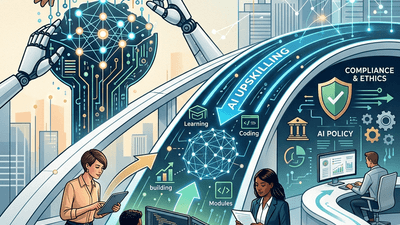



For the past three years, the corporate mandate surrounding Artificial Intelligence has been a frantic race to acquire external talent. Companies paid steep premiums for prompt engineers, machine learning specialists, and AI ethicists. But in 2026, the narrative is shifting from aggressive talent acquisition to strategic talent transformation. The tech industry’s obsession with hoarding external talent is fading, replaced by a pragmatic, inward-looking approach that forces HR to completely rethink its budget allocations.
This paradigm shift was recently crystallized by Match Group, the parent company of digital dating giants like Tinder and Hinge. The company announced a deliberate slowdown in hiring, not as a desperate cost-cutting measure, but as a calculated reallocation of capital. Their goal? Redirecting talent acquisition budgets toward employee training, upskilling, and the development of internal AI tools. It is a defining moment that signals a broader trend in U.S. workforce strategy: the era of "Build Over Buy."
The Match Group Blueprint: Funding AI Through Headcount Freezes
Match Group's strategy highlights a critical financial reality for modern HR leaders. Enterprise AI licenses, custom large language model (LLM) training, and comprehensive upskilling programs are astronomically expensive. For most organizations, these initiatives cannot be funded through new budget approvals; they must be subsidized by optimizing existing operational costs.
By slowing down external hiring, Match Group is effectively cannibalizing its recruiting budget to fund its AI transformation. This approach offers several distinct advantages that HR leaders across industries should note:
- Preserving Institutional Knowledge: Upskilling existing employees ensures that the people wielding new AI tools already understand the company's proprietary data, culture, and long-term objectives.
- Reducing Time-to-Productivity: External hires require months of onboarding. Internal employees trained on new AI tools can apply their enhanced productivity immediately to existing workflows.
- Boosting Retention Through Investment: In an era of economic anxiety, visibly investing in the future employability of your current workforce is a powerful retention mechanism.
"The transition to an AI-driven enterprise doesn't require replacing your workforce; it requires upgrading the workforce you already have. The companies that win will be those that treat AI as a tool for talent amplification, not talent replacement."
The Unintended Consequence: The Entry-Level Vacuum and the Intern Trap
While the "Build Over Buy" strategy is financially sound, it creates a dangerous operational vacuum at the bottom of the organizational chart. When headcount freezes are implemented to fund AI upskilling, middle managers are often left scrambling to manage baseline, entry-level workloads. Historically, when budgets tighten and entry-level hiring freezes, managers turn to HR with a familiar request: "Can we just get some unpaid interns to help out?"
This is where strategic workforce planning collides violently with labor compliance. As companies lean on internship programs to bridge the gap left by hiring slowdowns, the legal risks multiply. Courts and the Department of Labor (DOL) have cracked down aggressively on the practice of using unpaid interns as free labor, treating misclassification as a severe violation of the Fair Labor Standards Act (FLSA).
Navigating the FLSA's Primary Beneficiary Test
If your organization is scaling up its internship program to offset a hiring slowdown, HR must rigorously enforce the DOL's "Primary Beneficiary Test." This seven-factor test determines whether an intern is legally an employee entitled to minimum wage and overtime pay. The core philosophy is simple: if the company benefits more from the intern's labor than the intern benefits from the educational experience, the intern must be paid.
Here is a breakdown of how courts view the classification divide:
| FLSA Evaluation Factor | Compliant Unpaid Intern | Must Be Paid (Employee Status) |
|---|---|---|
| Educational Environment | Work mimics clinical or academic training. | Work is identical to standard entry-level tasks. |
| Displacement of Staff | Intern shadows existing staff; does not replace them. | Intern does work that a paid employee would otherwise do. |
| Academic Integration | Internship is tied to formal coursework or academic credit. | No connection to the intern's formal education. |
| Company Benefit | Company's operations may actually be impeded by training the intern. | Company derives immediate, direct economic benefit from the intern's work. |
In the context of an AI-driven hiring freeze, the "Displacement of Staff" and "Company Benefit" factors are the most dangerous tripwires. If a manager uses an unpaid intern to clean data sets for a new AI model because the company paused hiring for junior data analysts, that organization is actively violating the FLSA.
Action Plan: Balancing AI Transformation with Labor Compliance
For U.S. HR professionals, the intersection of Match Group's AI strategy and the strict realities of intern compliance requires a delicate balancing act. Here is how progressive HR departments can navigate this terrain in 2026:
- Audit Your "Build" Budget: Work with the CFO to map exactly how much capital is being saved by hiring slowdowns. Ensure those funds are genuinely ring-fenced for employee AI training and software licensing, rather than simply absorbed into general corporate profits.
- Formalize the AI Upskilling Curriculum: Don't just hand employees a ChatGPT Plus license and expect transformation. Develop structured learning paths. HR should track "AI proficiency" as a core competency during performance reviews.
- Transition to 100% Paid Internships: The legal risk, combined with the reputational damage of unpaid internships, is no longer worth it. If an intern is valuable enough to help your team during a hiring freeze, they are valuable enough to be paid at least minimum wage.
- Redesign Entry-Level Roles as "AI Apprenticeships": Instead of traditional internships, create paid AI apprenticeships. Bring in junior talent specifically to learn how to manage and optimize AI outputs alongside your newly upskilled senior staff. This solves the workload gap while building a compliant, future-proof talent pipeline.
The Future of the People Function
Match Group's pivot is not an isolated incident; it is a preview of the new normal. As AI capabilities mature, the intrinsic value of a company will rely less on its ability to recruit new talent, and more on its ability to maximize the potential of the talent it already possesses.
However, as HR leaders architect these high-tech workforce transformations, they must remain fiercely vigilant about foundational labor compliance. Innovation at the top of the organization cannot be subsidized by exploitation at the bottom. By combining aggressive internal upskilling with ethical, legally compliant early-career pipelines, HR can ensure that the transition to an AI-powered workforce is both economically viable and legally sound.